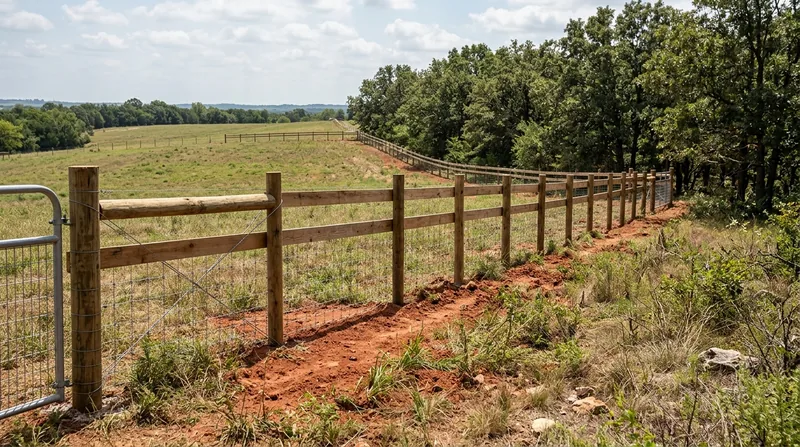




Farm fence installation in Tulsa means building barriers that hold livestock, mark property lines, and stand up to red clay ground and spring wind across Tulsa County acreage. Whether you're fencing pasture edges where post oak and blackjack oak line your property, or installing split rail and woven wire across open ground, the fence has to anchor deep and stay plumb through seasonal weather shifts. We install ranch fencing that works with the land, not against it, using materials and methods proven in this soil and climate. Tulsa Fence Pros has been building farm and ranch fences since 2014, and we know the difference between a fence that holds and one that fails in the first hard wind.
Why Farm and Ranch Fencing Matters in Tulsa County
Farm and ranch fencing does more than mark boundaries. It contains livestock, protects crops and equipment, defines pasture rotation, and adds resale value to acreage. In Tulsa County, post holes go into red clay that holds water and can shift with freeze-thaw cycles, and wind loads test every joint and fastener. A fence that isn't set properly or built with the right materials will lean, rack, or fail within a few seasons. The cost of replacing a failed fence is three to four times the cost of building it right the first time.
- Woven wire and T-post fencing contains livestock and costs less than wood rail but requires annual tension checks.
- Wood rail fencing (split rail or post-and-rail) suits horse and cattle pastures and lasts 15 to 20 years with proper post setting and wood species selection.
- Pipe fencing offers strength and longevity for high-traffic areas and gates, though initial cost is higher than wood or wire.
- Barbed wire and no-climb fencing add containment layers where livestock pressure is heavy or escape risk is high.
- Post spacing, concrete depth, and anti-sag bracing determine whether a fence stays true or begins to fail within the first year.
Getting the foundation right saves thousands in repair and replacement work down the road. For more on fence post repair and replacement, see our full post repair page.
Key info: Oklahoma law requires an 811 utility locate before any digging. Call 811 free of charge before we set posts, so we avoid hitting buried power, gas, water or communication lines. This is not optional and protects your property and our crew.
For permit requirements and setback rules in your area, check with your county building department or the Tulsa city planning office. Rules vary across Greater Tulsa, and deed restrictions or HOA architectural standards may limit fence height, material, or color on master-planned properties.
How We Install Farm and Ranch Fencing in Tulsa: Step-by-Step
We begin with a site walk to assess ground slope, soil condition, tree and rock obstacles, and the fence line you've marked or surveyed. We work from your existing survey and install on the line you identify. Then we locate all utilities with 811, set posts in concrete at proper spacing (typically 6 to 8 feet for rail fencing, 4 to 6 feet for wire), and build the fence level or stepped to follow grade. The method depends on material and terrain.
- We mark the fence line and confirm setbacks and corner visibility with property markers or your survey.
- We call 811 for a free utility locate and wait for the clearance before digging any post holes.
- We dig post holes to the depth required by soil type and frost depth, typically 30 to 42 inches in Tulsa County.
- We set posts in concrete, tamp the surrounding soil, and brace them plumb while the concrete cures.
- We attach rails or wire, tension wire fencing, and install gates and hardware to spec.
- We inspect the completed fence for plumb, tension, and proper hardware function before we leave the site.
A typical pasture fence across 200 linear feet takes two to three days with two installers. Larger acreage jobs or complex terrain may take a week or more.
Local example: A property in Jenks with a 400-foot pasture boundary and a 30-foot slope requires stepped installation (fence drops in height as the ground falls) rather than racked installation (boards angle to follow slope). Stepped fencing costs more labor but looks cleaner and protects the bottom rails from ground moisture and livestock damage.
For gate installation and automatic driveway gates, see our gate installation and repair page.
Farm and Ranch Fencing Methods and Materials
| Approach | Description | Best for |
|---|---|---|
| Woven Wire and T-Post | Galvanized or powder-coated steel T-posts driven into ground, woven wire (typically 4 to 6 gauge) stapled or clipped to posts. Fast to install, low initial cost, requires annual tension maintenance. | Pastures, temporary rotation fencing, budget-conscious acreage owners. |
| Wood Rail Fencing (Split Rail or Post-and-Rail) | Pressure-treated pine or cedar posts set in concrete, with 2x4 or 2x6 rails mortised or bolted to posts. Attractive, durable 15 to 20 years with proper wood species and post setting. Requires periodic staining or sealing. | Horse and cattle pastures, properties where appearance matters, long-term fencing investment. |
| Pipe Fencing | Galvanized or powder-coated steel pipe (typically 1.5 to 2 inch diameter) welded or bolted to posts. Highest strength-to-weight ratio, minimal maintenance, highest upfront cost. Lasts 25+ years. | High-traffic areas, gates, livestock containment where durability and low maintenance are priorities. |
| Barbed Wire and No-Climb Fencing | Barbed wire strung between posts for cattle, or no-climb fencing (vinyl-coated welded wire) for horses and goats. Barbed wire is cheap but requires careful handling; no-climb is safer for animals and more visible. | Cattle containment, layered fencing (typically above or below wood or pipe rails), pastures where escape risk is high. |
Farm and Ranch Fencing Cost in Tulsa: What to Expect
Farm fence installation in Tulsa starts at around $10 per linear foot for basic woven wire and T-post fencing on level ground with good access. Wood rail fencing runs $15 to $25 per linear foot depending on rail size, wood species (cedar costs more than pressure-treated pine), and post spacing. Pipe fencing runs $20 to $35 per linear foot because of material and welding labor. Barbed wire and no-climb fencing typically adds $2 to $5 per linear foot as a secondary layer.
Factors that move the price up include sloped or stepped installation (labor-intensive), rocky or clay-heavy soil (slower digging), tree and obstacle removal or avoidance, distance from your property to our shop (travel time), and the complexity of gates or special hardware. A 200-foot pasture fence on level ground with good access might cost $2,000 to $4,000 for wood rail. The same fence across a slope with trees and difficult soil could run $3,500 to $6,000.
The best way to get an accurate price is a free on-site estimate. We'll walk the property, assess the ground and obstacles, and give you a detailed breakdown of materials, labor, and timeline. Get 2 or 3 estimates so you can compare scope and pricing. See our full pricing page for more detail on materials and labor rates.
Farm and Ranch Fencing Near Me: What Tulsa Homeowners Should Know When Hiring
When you're looking for farm and ranch fencing near Tulsa, ask for proof of insurance (general liability and workers' compensation coverage). We are fully insured and can provide a certificate of insurance on request. In Oklahoma, fence installation is not regulated by a state license, but large projects (typically above $40,000) may require a licensed general contractor. Check with your local building department or county office to confirm what applies to your job size and scope.
Get multiple estimates and ask each contractor what's included in their price. Compare material quality, post spacing, concrete depth, and warranty or guarantee terms. Check references, especially from properties in Tulsa County where soil and weather are the same as yours. Ask whether they handle permits and utility locates, and whether they're an AFA member (American Fence Association). Call us at (918) 359-6903 for a free estimate with no obligation to book.
If your property is in a master-planned community or HOA, check the architectural guidelines before you start. Height, material, and color rules vary, and some associations require approval before installation begins. If your fence sits on a shared property line, confirm with your neighbor and check local fence responsibility rules (typically, the property owner who initiates the fence pays for it, but local law varies). For more on hiring and what to expect, contact us for a free estimate.
Farm & Ranch Fencing in Tulsa: Pricing Guide
| Service | Price | Details |
|---|---|---|
| Woven Wire and T-Post Fencing | Starting at $10/ft | Fast installation, low material cost, annual tension maintenance required for long-term performance |
| Wood Rail Fencing | Starting at $15/ft | Pressure-treated pine or cedar posts and rails, 15 to 20 year lifespan, periodic staining or sealing recommended |
| Pipe Fencing | Starting at $20/ft | Galvanized or powder-coated steel pipe, 25+ year lifespan, minimal maintenance, highest upfront cost |
| Sloped or Stepped Installation | Add $3-$8/ft | Terrain requiring stepped fence (drops in height as ground falls) or racked fence (boards angle to follow slope) |
| Site Estimate | Free | Response within 24 hours at (918) 359-6903, includes walk of property, ground assessment, material and labor breakdown |
Indicative pricing, the exact cost depends on square footage, finish, and site access. Free personalized estimate within 24h at (918) 359-6903.


