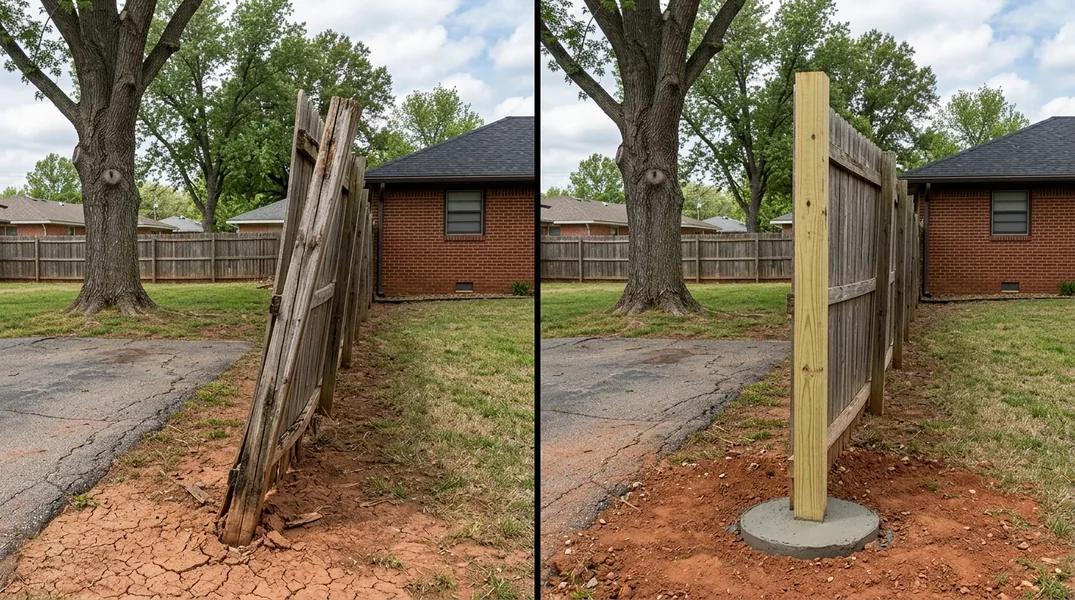
Understanding Tulsa's Red Clay Problem
When most homeowners think about threats to their fence, they imagine harsh winters with freeze-thaw cycles cracking wood and loosening posts. But here in Tulsa, the real culprit is often something far more insidious: our region's distinctive red clay soil. This heavy, mineral-rich clay presents challenges that can actually be more damaging to fence posts than any winter weather pattern.
Red clay is dense and expansive. When it absorbs moisture, it swells significantly. When it dries, it shrinks and pulls away from whatever is embedded in it, including your fence posts. This constant expansion and contraction cycle, which happens multiple times throughout the year in Tulsa, creates tremendous stress on wood posts. Over time, this movement loosens the post in its hole, causing the entire fence structure to become unstable. Unlike a single hard freeze that affects everything uniformly, this clay movement is relentless and ongoing, making it one of the most significant long-term threats to fence integrity in our area.
Why Red Clay Causes More Damage Than Winter Freeze-Thaw
A winter freeze-thaw cycle typically happens a handful of times each season. Water freezes, expands, and then thaws, creating stress that repeats perhaps five to ten times per year in a typical Tulsa winter. While this is certainly damaging, the red clay problem is exponentially worse because it happens constantly. Every time it rains and the soil absorbs moisture, expansion begins. Every time the sun beats down and the clay dries out, contraction occurs. In a humid climate like ours, this can happen multiple times per week, not just per season.
The mechanical stress from this repetitive movement is cumulative and unforgiving. Wood fibers begin to separate from the constant flexing. Nails and fasteners loosen. The post itself may begin to rot at the soil line where moisture is trapped by the clay's poor drainage. By contrast, winter freeze-thaw is a known challenge that builders in cold climates have learned to manage. Here in Tulsa, many fence installers underestimate the clay problem because they're focused on seasonal concerns. This is why choosing the right installation depth, post material, and drainage strategy is absolutely critical for Wood & Privacy Fence Installation in our region.
Best Post Materials for Tulsa's Clay Soil Conditions
Not all fence posts are created equal when it comes to surviving Tulsa's red clay. Pressure-treated wood is a common choice, but it still absorbs and releases moisture, making it vulnerable to the expansion-contraction cycle. Concrete posts are more stable, but they can still crack and shift if the clay movement is severe enough. Some homeowners and contractors have found success with steel posts set in concrete, which provides rigidity that resists the clay's movement. However, steel requires proper rust protection and isn't always the aesthetic choice for residential properties.
For Wood & Privacy Fence Installation, many experienced Tulsa contractors recommend using pressure-treated posts set deeper than standard depth (often 3 to 4 feet rather than 2 to 3 feet) with concrete footings that extend well below the active clay layer. Some also recommend adding a layer of gravel or sand around the post before backfilling with clay, which improves drainage and reduces the clay's direct contact with the wood. The key is understanding that in our soil, installation technique matters as much as material choice. When you're ready to discuss the best approach for your property, contact Tulsa Fence Pros for a free estimate and expert guidance.
Do I Need a Permit for a Fence in Tulsa?
Before you install any fence in Tulsa, you need to understand local regulations. Yes, you typically do need a permit for a fence, and this isn't just a bureaucratic formality. The permit process ensures your fence meets setback requirements, doesn't interfere with utilities, and complies with local codes. Tulsa's permitting system protects both you and your neighbors by establishing clear rules about where fences can be built and how they must be constructed.
The permit application requires you to specify the type of fence, its location on your property, its height, and the materials you'll use. This is where many homeowners run into surprises. Your fence height regulations in Tulsa typically limit front-yard fences to 4 feet and backyard fences to 6 feet, though these can vary by zoning district. Additionally, if your property is in an HOA-governed community, you'll need to ensure your fence design is HOA approved before you even apply for a city permit. Getting both approvals upfront saves time and prevents costly mistakes. Most reputable fence contractors in the area are familiar with these requirements and can guide you through the process.
Fence Height Regulations and HOA Approval in Tulsa
Tulsa's fence height regulations are straightforward but important. Front-yard fences are generally limited to 4 feet in height, measured from the finished grade. Backyard fences can typically reach 6 feet. However, these rules can be modified in certain zoning districts, and corner lots have additional restrictions to maintain sight lines for traffic safety. Before you commit to any fence design, verify the specific regulations for your property by checking with the City of Tulsa's Planning and Development Services or consulting with a local contractor who knows the codes inside and out.
If you live in a community with an HOA, the approval process adds another layer. Many HOAs have design guidelines that specify acceptable materials, colors, styles, and heights. An HOA approved fence might mean vinyl instead of wood, or a specific color palette, or a particular style of pickets. Some HOAs are quite restrictive, while others are more flexible. The important thing is to check your HOA documentation and submit plans for approval before you break ground. This prevents the frustrating scenario of installing a beautiful fence only to be told it violates community covenants. When you work with Wood & Privacy Fence Installation professionals, they can help navigate these requirements and ensure your project complies with both city and HOA rules.
Fence Permit Cost and Budget Considerations in Tulsa
Understanding fence permit cost helps you budget accurately for your project. In Tulsa, permit fees typically range from $25 to $75 depending on the scope of your project, though these fees can vary. The permit itself isn't expensive, but it's an easy cost to forget when budgeting. More important than the permit fee is understanding the total cost of installation, which depends on material choice, fence length, site conditions, and labor. Red clay installation challenges in Tulsa often mean contractors need to invest more time in proper post setting, which can affect overall pricing.
When you're evaluating pricing from different contractors, make sure they're accounting for Tulsa's specific soil challenges. A contractor who quotes significantly lower than others may not be planning for the deeper post holes, better drainage solutions, or superior concrete work that our clay soil demands. Quality installation that accounts for red clay expansion and contraction will cost more upfront but will save you money on repairs and replacement down the road. For a transparent quote that includes permit costs and accounts for local soil conditions, call Tulsa Fence Pros at (918) 359-6903 or request a free estimate online.
Looking for a professional tree service in Tulsa? Tulsa Fence Pros responds fast for all your fence needs.
Get a Free Quote